Category: Software Development & Security
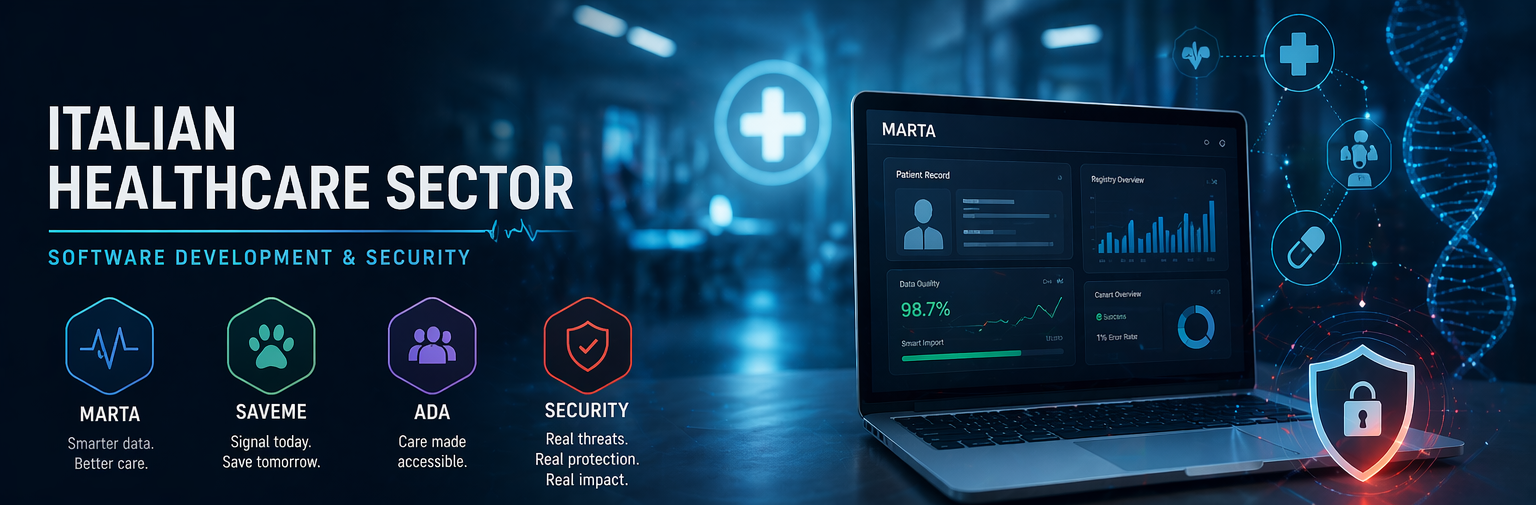
Projects: MARTA, SaveMe, ADA, Security Assessment
Security Assessment (Black Box Penetration Testing)
As part of our engagement in the healthcare sector, Sentinel rSoC conducted a black box penetration test on critical systems.
Operating with no prior internal knowledge (simulating a real external attacker) we identified a number of high-severity vulnerability that had not been detected by previous security assessments, including automated SAST tools and prior third-party reviews.
This finding highlighted:
- The limitations of purely automated security approaches
- The importance of real-world attack simulation
- The value of experienced, adversarial testing
Following discovery, we provided clear remediation guidance, enabling the organization to address a critical risk that could have led to significant data exposure.
MARTA
MARTA is a specialized platform developed for cancer registry departments, designed to handle complex healthcare data workflows with precision and reliability.
Unlike traditional consultation software, MARTA goes beyond simple data retrieval. It addresses real-world data inconsistencies and operational challenges through advanced processing capabilities, including:
- Intelligent handling of misspelled names and surnames
- Smart data import mechanisms, including automated splitting of combined fields (e.g., name/surname in a single cell) with a very low error rate
- Streamlined data management tailored to healthcare operators
The result is a system that significantly improves data quality, efficiency, and usability in critical healthcare environments.
SaveMe
SaveMe is a civic-focused platform designed to improve the reporting and handling of stray animal cases.
Users can quickly report sightings, and the system automatically routes the information to the appropriate department, enabling faster response and coordination. The platform reduces delays and ensures that responsible authorities are activated without manual intervention.
ADA
ADA was developed to simplify access to care services for elderly individuals.
The system introduces a voucher-based model that seamlessly connects:
- Citizens
- Local health authorities (ASL)
- Accredited care centers
By digitizing and streamlining this process, ADA makes it significantly easier for users to access services while improving coordination between institutions.